
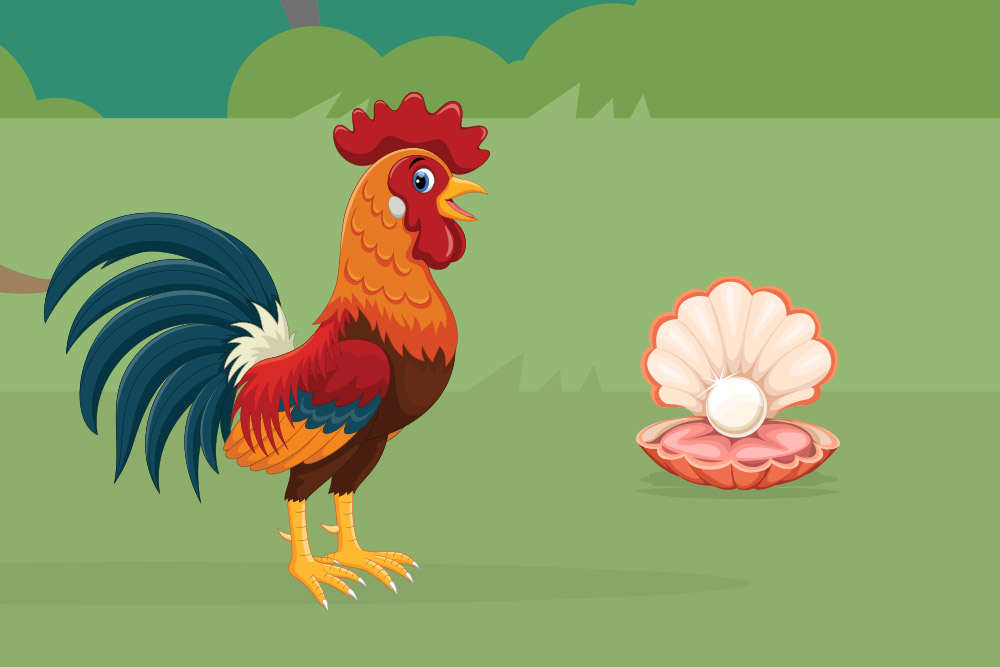
Once upon a time, in a world where bedtime stories for kids were filled with enchanting morals and whimsical tales, there lived a curious rooster whose story is as delightful as it is instructive. Amidst the vast treasury of fables attributed to the legendary storyteller Aesop, one particular tale stands out, known as “The Rooster and the Pearl.” This charming story takes us on a journey to discover the essence of wisdom, humility, and the everlasting quest for the extraordinary—a lesson that will surely captivate both young and old, as we explore the perplexing choices of a most peculiar rooster.
THE ROOSTER AND THE PEARL
A ROOSTER was once strutting up and down the farmyard among the hens when
suddenly he saw something shinning amid the straw. “Ho! ho!” he said excitedly,
“that’s for me,” and soon rooted it out from beneath the straw. What did it turn
out to be but a Pearl that by some chance had been lost in the yard? “You may
be a treasure,” said Master ROOSTER, “to men that prize you, but for me I would
rather have a single barley-corn than a peck of pearls.”
Precious things are for those that can prize them.
The moral of the fable
The lesson from Aesop’s fable “The Rooster and the Pearl,” is that we should always appreciate the value of what we have and not get carried away by the idea of something that seems more exciting or shiny.
In the story, the rooster gave up a precious pearl, which he didn’t understand the value of, for the mere possibility of finding a few grains of corn. This shows that sometimes we might chase after something that looks better, but in the end, it’s not as valuable as what we already have. It’s important to be grateful for what we have and not be easily swayed by the idea of something better, as it might not be as great as it seems.
So, the lesson is to be content with what you have and not let the pursuit of something new and shiny make you overlook the true worth of what’s already yours.
Advice for Kids
1. Value Simplicity: Just like the wise Rooster, learn to appreciate the simple joys in life. Sometimes, the most valuable things can be the ones right in front of you.
2. Don’t Chase After What Others Value: Understand that not everyone values the same things. It’s okay if you have different preferences and priorities. What’s important is what makes you happy.
3. Learn to Recognize True Treasure: While material things can be valuable, true treasure often lies in moments, relationships, and experiences. Cherish the people and experiences that make your life special.
If you ever feel unsure or encounter a situation that makes you uncomfortable, talk to a parent, teacher, or someone you trust. They are there to help and guide you through challenges, just like the wise sheep who shared their concerns with their fellow flock.
Interactive Activities for Kids
1. Treasure Hunt Game:
– Example: Create a list of items for kids to find around the house or in the backyard, such as a shiny coin, a smooth pebble, a feather, or a colorful leaf.
– Free Alternative: Instead of using physical objects, you can create a nature treasure hunt outdoors. Kids can find natural treasures like unique-shaped rocks, colorful leaves, feathers, or pinecones.
2. Pearl Art:
– Example: Provide art supplies like beads, buttons, and string for kids to create their own beaded jewelry or artwork.
– Free Alternative: Encourage kids to make their own art and crafts using household items. They can use paper, cardboard, old magazines, and recycled materials to create artwork, jewelry, or sculptures.
3. Gratitude Journal:
– Example: Have kids keep a physical journal where they write or draw things they are grateful for each day.
– Free Alternative: Kids can create a physical gratitude collage using pictures, words, or drawings from magazines, newspapers, or old cards to represent what they are grateful for.
4. Storytelling Time:
– Example: Kids can create their own short stories or fables about valuing simple things in life and share them with family and friends.
– Free Alternative: Kids can engage in storytelling by creating their own puppets from socks, paper bags, or craft sticks. They can act out the fable or tell their stories using these puppets, promoting creativity and imaginative play.